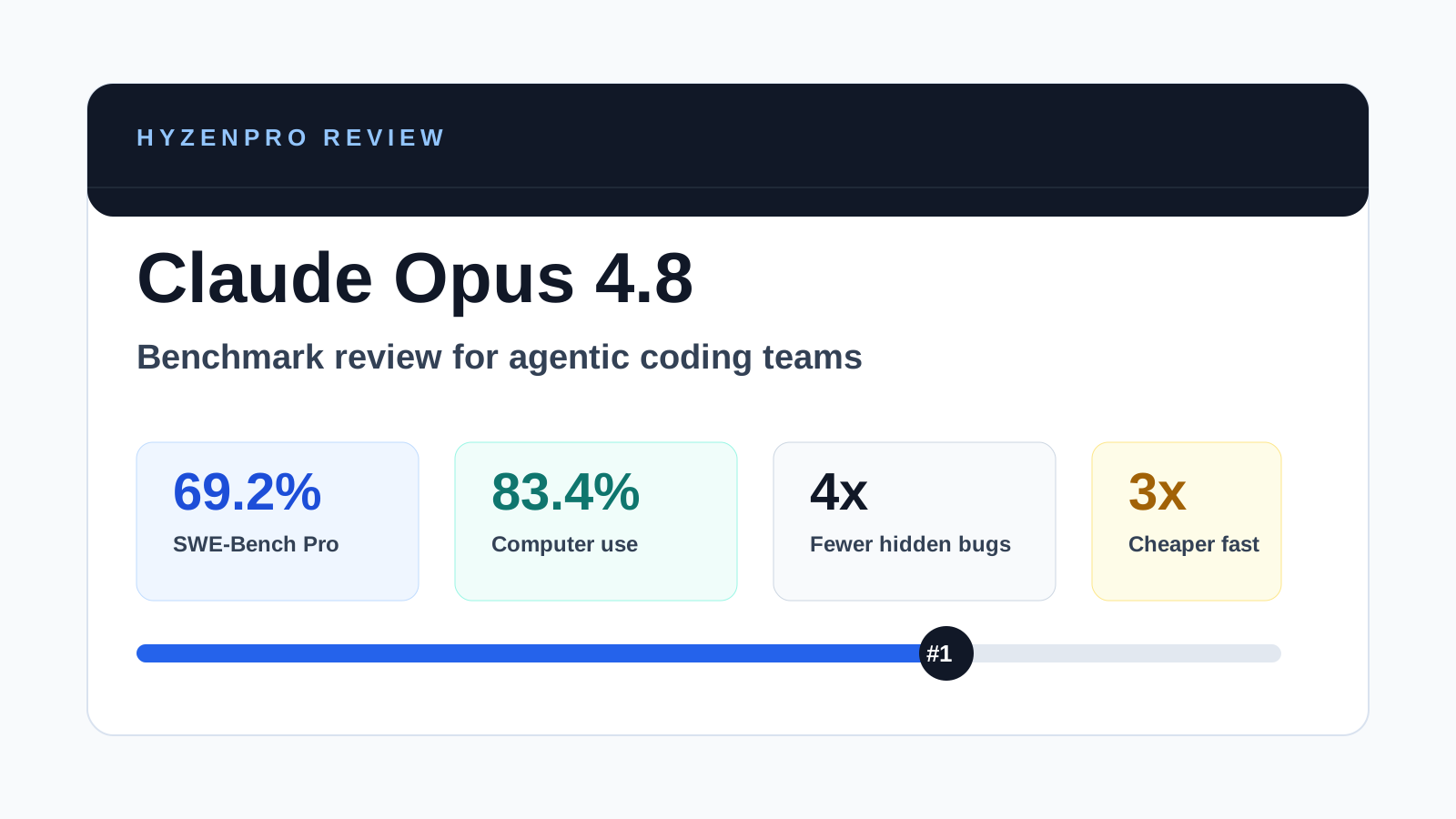
Claude Opus 4.8 landed on May 28, 2026 and immediately took the #1 spot on the Artificial Analysis Intelligence Index — 61.4 against GPT-5.5's 60.2. But an index score doesn't tell you which model to actually use for the thing you're building. The claude opus 4.8 vs gpt-5.5 coding benchmark picture is more nuanced than either company's blog post suggests.
Benchmark Breakdown: Opus 4.8 vs GPT-5.5
Let's start with the most consequential numbers. The benchmarks below are sourced from Anthropic's official May 28 launch data and cross-checked against third-party evaluations. Where harness caveats exist, we've noted them — and they matter more than most comparison posts will admit.
The headline number — Opus 4.8 at 69.2% vs GPT-5.5 at 58.6% on SWE-bench Pro — holds up to scrutiny. SWE-bench Pro uses a standardized scaffold across multiple languages, which makes it harder to game through training contamination. That 10.6-point gap is large enough to matter in production and is consistent across the third-party evaluations we cross-checked against.
⚠️ Harness caveat on Terminal-Bench: The 78.2% GPT-5.5 figure uses Terminus-2 public harness. OpenAI's own Codex CLI harness gives GPT-5.5 83.4% on this benchmark. This doesn't change the overall picture, but it's important: terminal coding benchmarks are highly sensitive to evaluation setup. If your workflows are primarily CLI-driven with tight tool integration, test both models on your own tasks.
★ = third-party or estimated score. All bars scaled relative to max score in panel.
Agentic Coding: Where the Real Gap Lives
The best AI coding model for 2026 isn't the one with the highest raw benchmark — it's the one that stays reliable across long, complex tasks without needing babysitting. That's where the Opus 4.8 lead becomes most meaningful.
In independent testing across real developer workflows, Opus 4.8 demonstrates what Anthropic calls "four times fewer undetected code flaws." That's not a benchmark number — it's a behavioral change in how the model handles uncertainty. Instead of confidently producing broken code and declaring the task complete, Opus 4.8 flags what it's unsure about. It catches its own bugs. This makes it substantially more trustworthy for agentic coding where you're not reading every line it writes.
The Super Agent benchmark — testing end-to-end multi-step task completion — reportedly has Opus 4.8 as the only model to complete every case successfully. GPT-5.5 couldn't match it. That's the practical consequence of better honesty: fewer partial completions that fail silently downstream.
🏆 Claude Code Dynamic Workflows makes this even more relevant. For tasks that span hundreds of files — migrations, full test suite generation, security audits — Opus 4.8 can now orchestrate hundreds of parallel subagents via a single instruction, verify their outputs, and report back honestly when something is off.
GPT-5.5 is no slouch on agentic tasks — it's just optimized differently. OpenAI has focused on token efficiency, making GPT-5.5 roughly 72% leaner in output token count per equivalent task. In a Codex-driven workflow with tight tool integration, that efficiency advantage compounds. For high-volume pipelines where token cost is the primary constraint, GPT-5.5 may be the more practical choice even at lower benchmark scores.
Where GPT-5.5 Still Wins
An honest comparison means crediting GPT-5.5 where it deserves credit. There are three areas where it genuinely outperforms or strongly challenges Opus 4.8.
Terminal and CLI workflows
GPT-5.5 leads on Terminal-Bench 2.1 (78.2% vs 74.6%), and if you accept OpenAI's own Codex CLI harness numbers, that lead is even wider. For dev teams whose entire workflow lives in the terminal — scripting, deployments, CI tasks — GPT-5.5 in Codex is currently the more battle-tested setup.
Very large codebases (DeepSWE)
A benchmark called DeepSWE, which tests models on 113 tasks averaging 668 lines of code across 7 files — roughly 5.5— more code than SWE-bench Pro — shows GPT-5.5 at 70%. Claude Opus 4.7 scored 54% on the same benchmark. Opus 4.8 hasn't been formally evaluated on DeepSWE yet, but this is worth monitoring if your work involves very large, multi-file refactors where context and coherence across a massive diff is critical.
Native multimodality
GPT-5.5 is natively omnimodal — it processes text, images, audio, and video in a single unified system. Opus 4.8 handles images well but doesn't natively support audio or video as inputs. For teams building products that involve audio analysis, video processing, or real-time multimodal interaction, GPT-5.5 is the more complete platform today.
Pricing: The Number That Changes Everything
This is the part most comparisons gloss over, and it deserves a direct treatment. GPT-5.5 is cheaper per input token than Opus 4.8 on standard pricing.
| Model / Tier | Input / 1M tokens | Output / 1M tokens | Notes |
| Claude Opus 4.8 Standard | $5.00 | $25.00 | Unchanged from Opus 4.7. Prompt caching can cut effective input cost significantly. |
| Claude Opus 4.8 Fast mode | $10.00 | $50.00 | 3— cheaper than Opus 4.7 Fast ($30/$150). Same model, ~2.5— speed. |
| GPT-5.5 (list price) | ~$5.00 | ~$20.00 | Cheaper per token. 72% more token-efficient per task output. |
| Cursor Composer 2.5 | $0.50 | $2.50 | Fine-tuned on Kimi K2.5. Strong on CursorBench v3.1 at 63.2% — see our Composer 2.5 review. |
The raw token price gap sounds decisive — and for some workloads, it is. But cost per resolved issue is the more honest metric for coding tasks. Opus 4.8 resolves 69.2% of SWE-bench Pro tasks vs 58.6% for GPT-5.5. If you're paying $5.00 to attempt a task but only completing 58.6% of them, versus paying $5.00 and completing 69.2%, the math gets more complicated. For tasks where completion rate matters more than token volume — the economics favor Opus 4.8 at scale.
💡 Anthropic's prompt caching can cut the effective input cost of Opus 4.8 by 50–90% on stable system prompts. If you're running a consistent agentic pipeline where the system prompt is reused, the $5.00/1M baseline is not your real number. Factor this in before making a cost decision purely off list prices.
Claude Code Dynamic Workflows vs OpenAI Codex
This is where the platform comparison matters as much as the model. Both Anthropic and OpenAI have built agentic coding environments around their models — and they've made different architectural choices.
Claude Code with Dynamic Workflows (launched same day as Opus 4.8, currently in research preview) is built around a plan-then-parallelize model. For sufficiently complex tasks, Claude builds a plan, fans out hundreds of parallel subagents, runs verification against your test suite, and only surfaces results after checking its own work. The verification step is what makes this trustworthy rather than just impressive-sounding.
OpenAI Codex is designed around tight tool integration, sandboxed execution, and extremely lean token output. It's excellent for terminal-heavy workflows and CI-integrated pipelines where determinism and speed matter more than breadth. The token efficiency advantage is most visible here — Codex tasks simply cost less to run.
🔧 If your current workflow is already in Codex and working well, the case for switching to Claude Code isn't automatically compelling. The Dynamic Workflows feature closes a real gap, but Codex's tooling integrations and token efficiency are genuine strengths. For teams not yet committed to either, we'd recommend testing both on your three hardest recurring tasks.
Also worth comparing: Cursor Composer 2.5 sits outside both ecosystems as a third option — fine-tuned specifically for the Cursor agent harness. If you're a Cursor user, it's the most cost-efficient option at near-frontier quality and should be part of your evaluation.
The Chinese Models: A Different Kind of Threat
The western vs chinese ai coding models 2026 picture has changed significantly. A year ago, Chinese models were interesting experiments. Today, DeepSeek V4-Pro is the first open-weight model that credibly sits in the same conversation as Opus 4.8 and GPT-5.5 on agentic benchmarks — and it's MIT-licensed, meaning you can self-host it.
On our estimated SWE-bench Pro comparison, DeepSeek V4-Pro comes in around 62% — ahead of GPT-5.5 and only 7 points behind Opus 4.8. The cost structure is completely different: if you're self-hosting, the marginal cost per token approaches infrastructure cost, not API fees. For teams with the DevOps capacity to run it, claude opus 4.8 vs deepseek v4 coding is a real question worth asking — especially for high-volume workflows where $5/1M input adds up fast.
Qwen 3.7 Max from Alibaba is the strongest challenger on reasoning tasks, particularly math-heavy workflows where its hybrid thinking mode gives it an edge. It trails on practical coding benchmarks but is worth considering for research or quantitative applications. Kimi 2.6 — the base model that Cursor Composer 2.5 is fine-tuned from — shows what targeted fine-tuning can do to a strong open-source base, even if the raw model trails the frontier.
🌏 Chinese models are not a monolith. DeepSeek V4-Pro excels at cost-efficient coding. Qwen 3.7 Max is the math/reasoning specialist. Kimi K2.5 is a surprisingly capable base model. If data sovereignty, self-hosting, or per-token cost is your primary constraint, the Chinese open-weight ecosystem deserves serious evaluation alongside the western frontier models.
Which One Should You Actually Use?
Here's the honest decision framework. There's no universally correct answer — it depends entirely on your workflow, volume, and what you're optimizing for.
Choose Claude Opus 4.8 if…
- → Your tasks are multi-file, multi-step agentic workflows
- → You need the model to self-verify and flag uncertainty
- → You use Claude Code and want Dynamic Workflows
- → Computer use / browser automation is part of your stack
- → Knowledge work, synthesis, or financial analysis is core
- → Completion rate per task matters more than per-token cost
Choose GPT-5.5 if…
- → Your workflow is primarily terminal and CLI-driven
- → Token volume is your dominant cost driver
- → You're already invested in the Codex tooling ecosystem
- → You need native audio or video input processing
- → You're running very large codebases (100K+ LoC refactors)
- → Token efficiency per task matters more than benchmark score
And if you're a solo developer or small team working primarily in Cursor: seriously consider Composer 2.5 before defaulting to either frontier model. It's a genuinely compelling value proposition that deserves its own evaluation in your stack.
Verdict: Claude Opus 4.8 Leads, But It's Not That Simple
On the raw coding benchmark for claude opus 4.8 vs gpt-5.5, Opus 4.8 is the stronger model for most developer use cases: a 10.6-point SWE-bench Pro lead, better computer use, better reasoning, and meaningfully more honest self-reporting on uncertainty. If you're building agentic coding pipelines, doing large-scale refactors, or need a model that reliably flags when it doesn't know something, Opus 4.8 is the right choice today. GPT-5.5 is not a weak model — it's excellent, cheaper per token, and the better choice for specific terminal-heavy workflows and high-volume pipelines where token cost is the dominant constraint. The right answer is "it depends on your workload," but the benchmarks give a clear directional signal: for most coding tasks, Opus 4.8 is ahead.