HyzenPro
Home
AI Tools
Blog
Compare
Submit Tool

Discover

  • AI Tools DirectoryBrowse the full AI tool library
  • Find ToolsUse the guided matcher quiz
  • CompareShortlist tools side by side

Popular Categories

  • AI Video ToolsEditors, generators, captions
  • AI Writing ToolsContent, copy, and SEO writing
  • AI Coding ToolsAssistants for developers

For Vendors

  • Submit AI ToolGet listed on HyzenPro
  • Vendor PortalManage your listing

From the Blog

Latest insights on AI tools

View all
ReviewClaude Opus 4.8 ReviewRead articleMarketing20 Best AI Marketing Tools in 2026Read articleVideo20 Best AI Video Generation Tools in 2026Read articleWritingHow to Choose an AI Writing ToolRead articleAutomationAI Automation Tools That Save 15 HoursRead articleGuideBest AI Tools for Small Business OwnersRead article

Learn

  • GuidesHow we evaluate AI software
  • ReviewsHands-on analysis and verdicts
  • Latest Blog PostsResearch, news, and tool guides

Company

  • About HyzenProWhat we cover and why
  • ContactQuestions, corrections, and partnerships
  • AdvertiseReach AI software buyers
HyzenPro
HomeAI ToolsFind ToolsBlogCompareGuidesAboutContact
Submit a Tool

Stay Ahead with AI

Get weekly AI tool reviews, comparisons & tutorials delivered to your inbox.

HyzenPro logo

Focused AI tool reviews, comparisons, and matchers for creators, marketers, and lean teams.

Blog

  • Latest Posts
  • Reviews
  • Tutorials
  • Comparisons

Guides

  • Small Business AI Tools
  • AI Automation Guide
  • AI Writing Tool Guide
  • AI Marketing Tools
  • AI Video Tools

Company

  • About Us
  • Contact
  • How We Test
  • Advertise
  • Submit Tool

Legal

  • Privacy Policy
  • Terms of Service

Latest from the Blog

View all posts
01

12 Best AI Automation Tools for Businesses to Save Time an…

Jun 9, 2026
02

Best AI Productivity & Automation Tools for Businesses (20…

Jun 9, 2026
03

15 Best AI Productivity Tools for Small Businesses in 2026

Jun 9, 2026
04

Claude Opus 4.8 Review: The Most Honest Coding Model Anthr…

May 28, 2026

© 2026 HyzenPro. All rights reserved.

Made with ❤️ for the AI community

HomeBlogLiquid AI Review: The End of Cloud-Only Intelligence?
Reviews

Liquid AI Review: The End of Cloud-Only Intelligence?

Liquid AI: Privacy-first, edge-native LFMs with sub-20ms latency. Escape the GPU tax with efficient, local AI.

Rana AqibJanuary 14, 20265 min read
Affiliate disclosure: HyzenPro may earn a commission when you click some tool links. Our reviews, comparisons, and recommendations remain editorially independent and are based on research, hands-on testing, pricing checks, and practical fit.
Liquid AI Review: The End of Cloud-Only Intelligence?

The current AI landscape is dominated by a heavy “GPU Tax”—the massive computational cost and energy required to run powerful models—along with growing concerns over the privacy risks inherent in sending sensitive data to the cloud. For businesses and developers, this status quo is becoming unsustainable. This is where Liquid AI enters the conversation. As I will explore in this Liquid AI Review, this technology isn’t just another Large Language Model (LLM) trying to compete on parameter count. It represents a fundamental shift in how artificial intelligence is built and deployed, moving us away from massive server farms and toward a more efficient, agile future.

What is Liquid AI?

To understand the hype, one must first define Liquid Foundation Models (LFMs). Unlike the Generative Pre-trained Transformers (GPTs) that currently rule the market, Liquid AI utilizes a novel non-transformer architecture rooted in Liquid Neural Networks.

This architecture is inspired by the biological brains of small organisms, designed to be incredibly adaptive. While transformers process data in static chunks, Liquid Neural Networks excel at handling sequential data with fluidity. This allows the system to learn and adapt continuously after training, rather than being “frozen” in time. It is a breakthrough that addresses the rigid nature of traditional deep learning, offering a system that is not only smarter but significantly more adaptable to changing data streams.
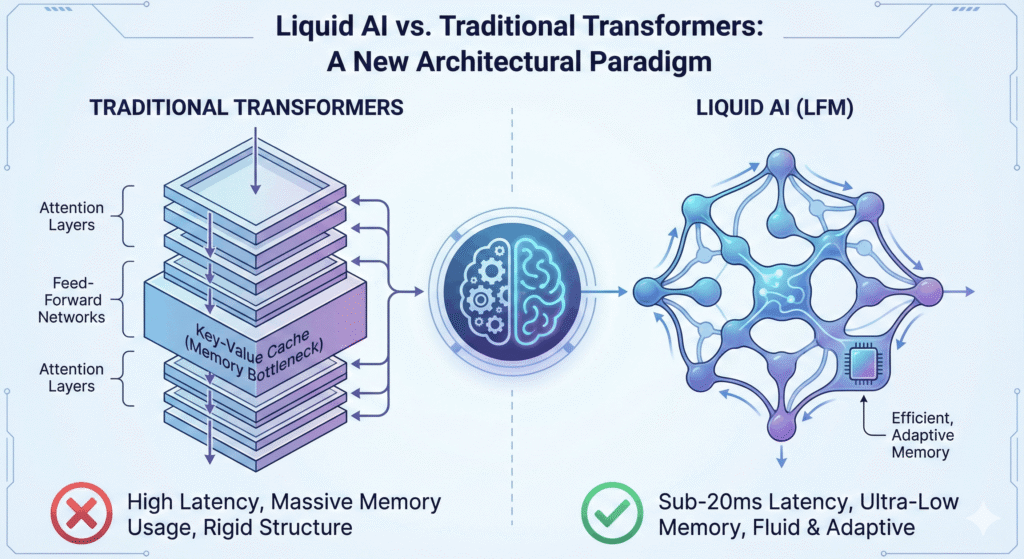
what is liquid ai

Performance & Efficiency

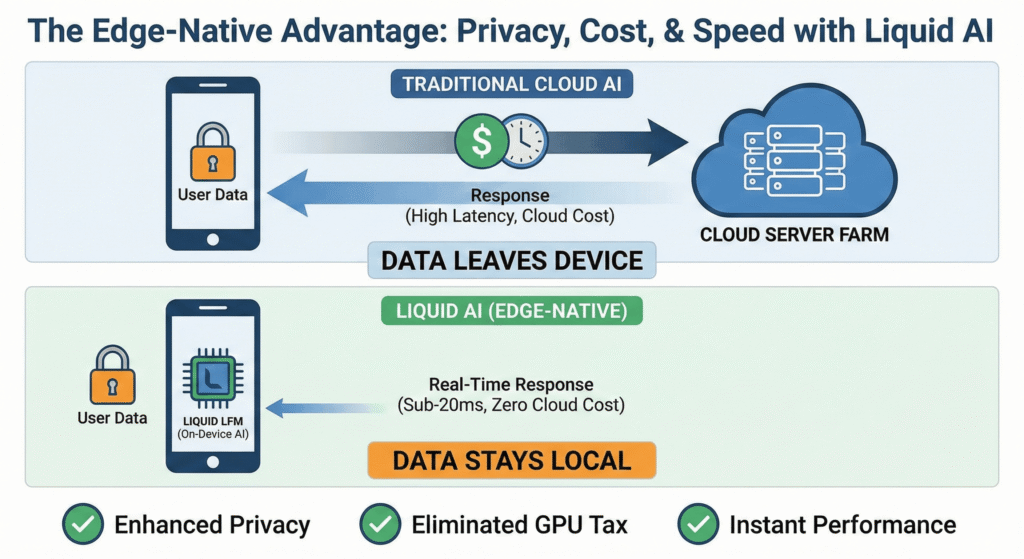
When comparing LFM vs Transformer models, the efficiency gains are startling. Traditional transformers require immense memory bandwidth to store the history of a conversation (the Key-Value cache), which grows linearly with the text length. Liquid’s architecture bypasses this bottleneck, offering unparalleled memory efficiency.

This efficiency translates directly to speed. The models are capable of achieving sub-20ms latency, a feat that is often impossible for standard LLMs without massive hardware acceleration. This enables true hardware optimization, allowing powerful AI to run on a wide variety of devices, from standard CPUs and GPUs to specialized NPUs. Furthermore, when benchmarking SLM (Small Language Models) performance, Liquid’s approach punches far above its weight class, delivering intelligence that rivals much larger models while consuming a fraction of the power.
Performance & Efficiency

Solving User Pain Points

The primary appeal of Liquid AI lies in how it solves critical implementation hurdles. First and foremost is data privacy. By enabling on-device AI and local AI execution, sensitive user data never needs to leave the device. This is a game-changer for healthcare, finance, and enterprise sectors where privacy is non-negotiable.

Secondly, there is the benefit of zero cloud costs. By eliminating the need for constant, expensive cloud API calls, businesses can drastically reduce their operational overhead. Finally, the edge-native design unlocks real-time AI performance in environments where internet connectivity is unreliable or latency is unacceptable. From robotics reacting to physical obstacles to Liquid AI vs Llama 3 comparisons in offline capabilities, the ability to process data locally and instantly opens up new frontiers for autonomous systems and commerce.

The Ecosystem: LFM 2.5, LEAP & Apollo

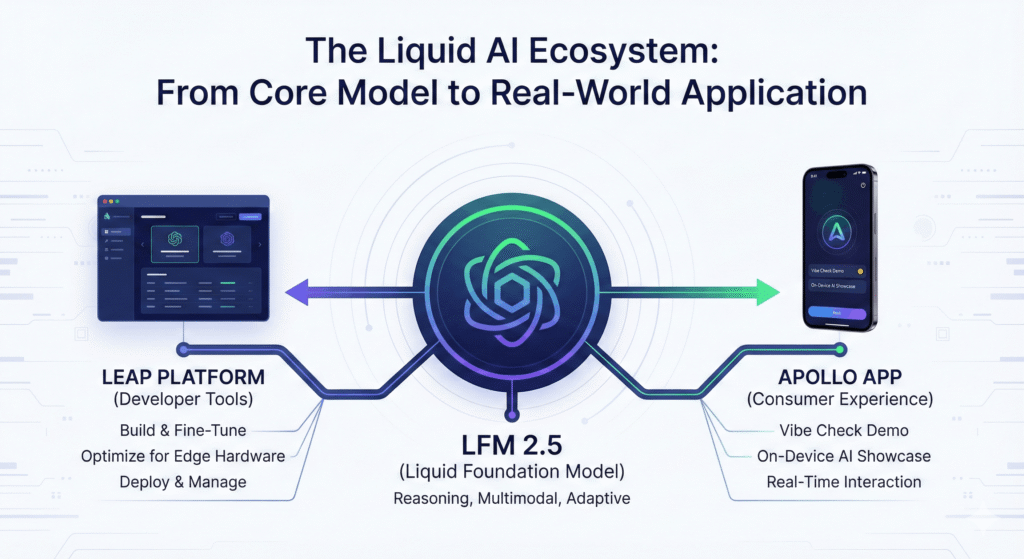
Liquid AI is not just a model; it is a growing ecosystem. The company has released LFM 2.5, the latest iteration of its Liquid Foundation Models, which further refines its reasoning and multimodal capabilities.

For developers, the LEAP platform provides the necessary tools to build, fine-tune, and deploy these models specifically for edge environments. It simplifies the complexity of getting a model running on specific hardware. On the consumer side, the Apollo app serves as a mobile “vibe check,” allowing users to experience the fluidity of the technology firsthand on their phones. It acts as a tangible demonstration of how LFM 2.5 and other models in the suite function in a real-world, constrained environment.
Conclusion

So, is the hype justified? In this Liquid AI Review, the final verdict is a resounding yes—specifically for edge cases and privacy-first requirements. Liquid AI is highly credible for organizations looking to escape the cloud processing trap. While massive cloud models will likely remain dominant for general-purpose reasoning, the future is undeniably hybrid. We are moving toward a world where specialized local AI execution works alongside general cloud models, and Liquid AI is leading that charge.

How HyzenPro Evaluated Liquid AI Review

This article is maintained as part of HyzenPro's AI Models coverage. We evaluate each tool through practical buyer questions: what the product is best at, where it creates friction, how pricing changes with real usage, and which alternatives make more sense for different teams.

Best for

Liquid AI Review is most useful when the buyer already knows the workflow they want to improve and needs a clear recommendation rather than a feature dump. We look at setup time, output quality, collaboration features, export options, and whether the tool saves enough time to justify its monthly cost.

Skip if

Skip this option if your team needs deep enterprise controls, custom procurement terms, or a workflow that the product does not directly support. In those cases, compare it with category alternatives in the HyzenPro AI tools directory before committing to an annual plan.

Pricing and value notes

Pricing changes often in the AI software market, so HyzenPro treats the public plan page as the source of truth and focuses on practical value: free-tier limits, export restrictions, watermarking, collaboration seats, usage credits, and upgrade points that can surprise creators or small teams.

Recommended next steps

Start with a small project, export the final result, and compare the output against at least one competing tool. If the tool reduces manual work without hurting quality, it belongs on your shortlist. If the workflow still needs heavy cleanup, choose a more specialized alternative.

Continue your research

Build a stronger shortlist

AI tools directoryBrowse every published AI tool review and category page.AI tool matcherUse guided questions to move from research to a practical shortlist.How we test AI toolsReview the evaluation method behind HyzenPro recommendations.
HyzenPro AI Tool Matcher

Want a faster path to the right AI tool?

Use the matcher hub to move from broad browsing into a guided shortlist based on workflow, budget, and team context.

Open the matcher hubBrowse the full directory

About the Author

RA

Rana Aqib

AI Workflow Researcher

Rana Aqib covers AI automation, video tools, coding assistants, and emerging productivity software. His reviews emphasize repeatable testing, buyer tradeoffs, and clear recommendations for different user types.

Expert Verified
Hands-on Testing
Website

Share This Article

TABLE OF CONTENTS

  • What is Liquid AI?
  • Performance & Efficiency
  • Solving User Pain Points
  • The Ecosystem: LFM 2.5, LEAP & Apollo
  • Conclusion
  • How HyzenPro Evaluated Liquid AI Review
  • Best for
  • Skip if
  • Pricing and value notes
  • Recommended next steps

Related Articles

Claude Opus 4.8 Review: The Most Honest Coding Model Anthropic Has Built
AI Coding ToolsAI Chatbots
HyzenPro EditorialMay 28, 202612 min

Claude Opus 4.8 Review: The Most Honest Coding Model Anthropic Has Built

Claude Opus 4.8 launches May 28 with 69.2% SWE-bench Pro, 83.4% computer use, dynamic parallel workflows & Fast mode 3x cheaper. Full benchmark review.

Read More
OpenClaw Review: Best Open-Source Agentic AI Gateway for Messaging Apps (2026)
AI ToolsReviews
HyzenPro TeamMay 24, 20263 min

OpenClaw Review: Best Open-Source Agentic AI Gateway for Messaging Apps (2026)

OpenClaw 2026 review — open-source agentic AI gateway for custom workflows, messaging integration, features, deployment, and pros/cons vs Hermes Agent.

Read More
Hermes Agent Review: Top Self-Improving Open-Source Agentic AI (2026)
AI ToolsReviews
HyzenPro EditorialMay 24, 20263 min

Hermes Agent Review: Top Self-Improving Open-Source Agentic AI (2026)

Hermes Agent by Nous Research 2026 review — self-improving open-source agentic AI with pricing, setup, memory capabilities, pros/cons vs Manus and OpenClaw.

Read More

Stay Ahead with AI

Get weekly AI tool reviews, comparisons & tutorials delivered to your inbox.

HyzenPro logo

Focused AI tool reviews, comparisons, and matchers for creators, marketers, and lean teams.

Blog

  • Latest Posts
  • Reviews
  • Tutorials
  • Comparisons

Guides

  • Small Business AI Tools
  • AI Automation Guide
  • AI Writing Tool Guide
  • AI Marketing Tools
  • AI Video Tools

Company

  • About Us
  • Contact
  • How We Test
  • Advertise
  • Submit Tool

Legal

  • Privacy Policy
  • Terms of Service

Latest from the Blog

View all posts
01

12 Best AI Automation Tools for Businesses to Save Time an…

Jun 9, 2026
02

Best AI Productivity & Automation Tools for Businesses (20…

Jun 9, 2026
03

15 Best AI Productivity Tools for Small Businesses in 2026

Jun 9, 2026
04

Claude Opus 4.8 Review: The Most Honest Coding Model Anthr…

May 28, 2026

© 2026 HyzenPro. All rights reserved.

Made with ❤️ for the AI community