
AI Coding Tools · Head to head
AccInt vs GPT-5.5
Both are listed under AI Coding Tools. AccInt is free; GPT-5.5 is free plan, paid upgrades. Their listed features do not overlap, so the choice comes down to what you need done.

At a glance
| AccInt | GPT-5.5 | |
|---|---|---|
| Pricing | Free | Free plan, paid upgrades |
| Free to start | Yes | Yes |
| Category | AI Coding Tools | AI Chatbots |
| Features listed | 5 | 6 |
Features compared
Only AccInt
- Scored retrieval and reusable paths
- Outcome-based credit assignment
- Local-first SQLite substrate
- MCP integration
- Claude Code, Codex, Cursor, and OpenCode workflows
Only GPT-5.5
- Agentic autonomous execution layer
- Latest flagship reasoning model
- Native multimodal video & audio processing
- Real-time voice and vision interactions
- Advanced tool utilization & web browsing
- Exceptional code refactoring capabilities
Strengths and drawbacks
AccInt
GPT-5.5
- + Unmatched agentic planning and autonomous task execution
- + Superior multimodal processing (video, audio, code)
- + Instant real-time conversational voice capabilities
- + Massive developer and enterprise ecosystem
- − Flags higher API costs at flagship pricing tiers
- − Inference time increases during complex agentic reasoning
- − Structured writing can sometimes feel less natural than Claude 4.7
Which one to pick
Choose AccInt if
- You need scored retrieval and reusable paths.
- You need outcome-based credit assignment.
- You need local-first SQLite substrate.
Choose GPT-5.5 if
- You need agentic autonomous execution layer.
- You need latest flagship reasoning model.
- You need native multimodal video & audio processing.
About each tool
AccInt
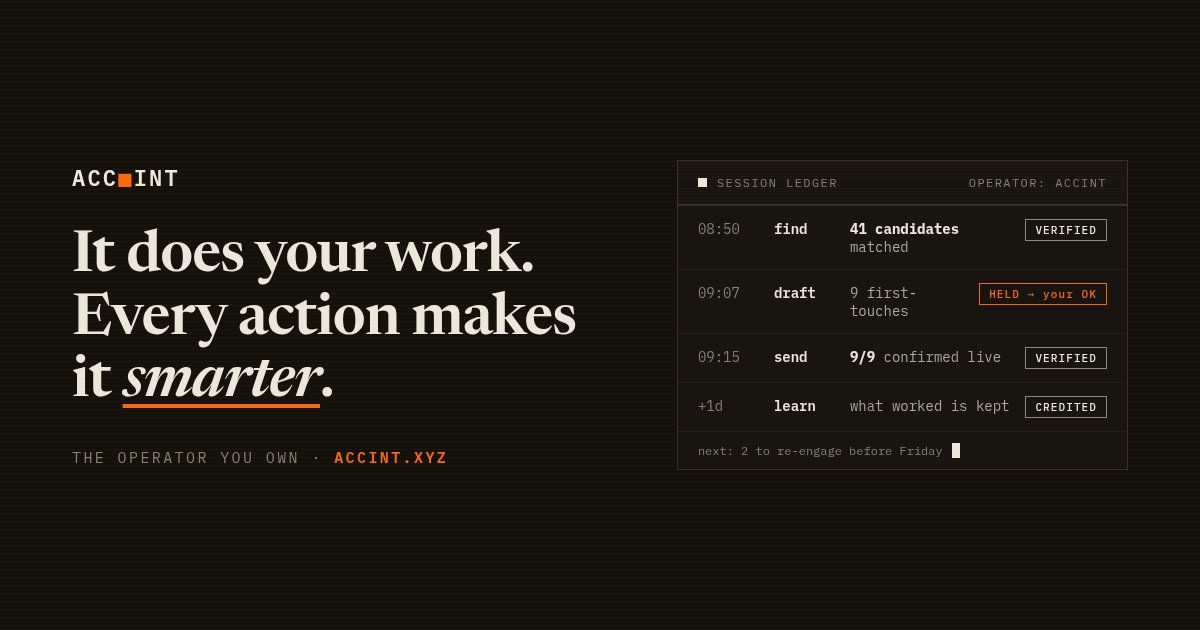
AccInt is a local-first Work Model for recurring AI agent work. It gives agents scored memory, commitments, outcomes, and credit assignment so useful context compounds from real results across Claude Code, Codex, OpenCode, Cursor, and MCP-capable workflows. It is for developers and teams who want agent memory grounded…
GPT-5.5
GPT-5.5 represents the absolute peak of OpenAI's agentic AI systems in 2026. Built specifically to power autonomous workflows, codebases, and real-time voice/vision interfaces, it operates as a full-fledged AI operating system layer.By combining superior multimodal intelligence, massive context window memory, and…