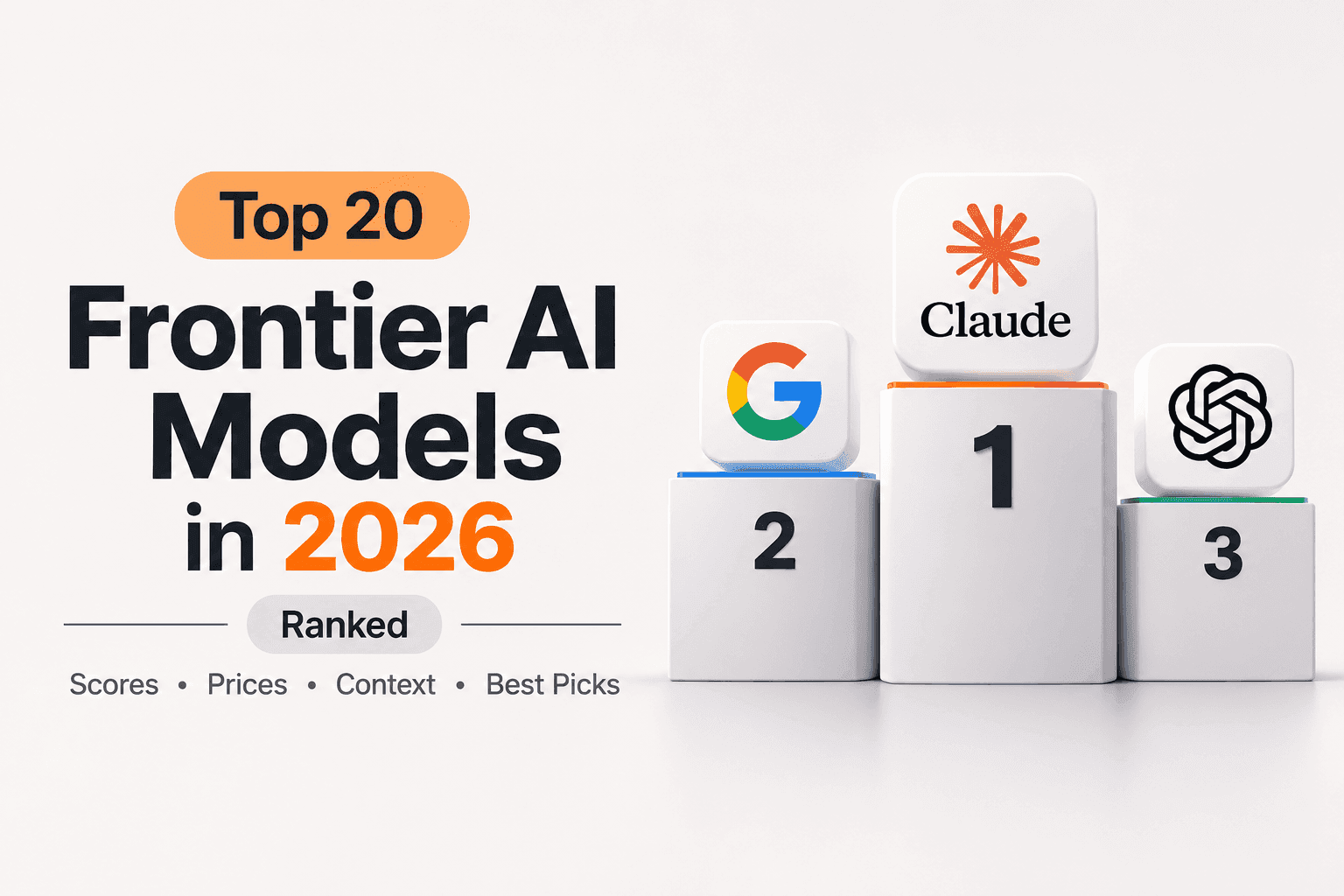
Claude Fable 5.2 is the strongest frontier AI model right now. It scores 93.3 on BenchLM's index, ahead of Gemini 4 Neon at 91.3 and GPT-6.2 Astra at 90.8.
The top three sit close together, though, and price changes the answer fast. Neon gets 98% of Fable's score for under 40% of the price.
Below is the full top 20. You get each model's score, API price, context window and who it's actually for. Seven of the 20 have already been replaced by newer versions. We flag them so you don't pick one by mistake. Want to re-rank them for your own work? Use our live AI leaderboard.
Quick answer: which frontier AI model should you pick?
Best overall: Claude Fable 5.2 (93.3). See its Claude Fable 5.2 leaderboard entry.
Best value near the top: Gemini 4 Neon (91.3) at $3 / $15 per million tokens.
Cheapest frontier API: GPT-6.1 Terra at $1 / $5.
Not sure which one fits your work? Take our AI tool matcher quiz and get a shortlist in two minutes.
What is a frontier AI model?
A frontier AI model is one of the highest-scoring models available at a given moment. It's a rank, not a spec sheet. A model is "frontier" only compared with everything else on the market, and that line moves every few weeks.
Every frontier model is a foundation model: a large model trained broadly, then adapted to many tasks. Most foundation models are not frontier. BenchLM draws the line at the top 10 on its public board. We stretch it to 20 so you can see the next tier too.
How we ranked these 20 models
Every score comes from BenchLM's November 21 leaderboard. We didn't re-run the benchmarks ourselves. We use one source so every row is measured the same way. Mixing launch-day charts from different labs makes a table look precise while ranking nothing.
The overall score blends six areas: agentic work (25%), coding (25%), reasoning (20%), knowledge (15%), math (10%) and instruction following (5%). Preference ratings add up to 10% more. Multimodal and multilingual are scored separately and don't count toward the overall number. You can read the details in BenchLM's scoring methodology.
Three things to know before you read the list:
Prices are list API rates per million input / output tokens.
"Superseded" means the lab has shipped a newer version.
Other leaderboards weigh things differently. Don't compare raw scores across sites. Compare the order instead.
Want to know how we review tools? Read how we review AI tools.
The top 20 frontier AI models at a glance
Rank | Model | Lab | Score | Price (in / out per 1M) | Status |
|---|---|---|---|---|---|
1 | Claude Fable 5.2 | Anthropic | 93.3 | $8 / $40 | Current |
2 | Gemini 4 Neon | 91.3 | $3 / $15 | Current | |
3 | GPT-6.2 Astra | OpenAI | 90.8 | $8 / $40 | Current |
4 | Gemini 4 Carbon | 88.3 | $2 / $10 | Current | |
5 | GPT-6 Astra | OpenAI | 83.6 | $10 / $50 | Superseded |
6 | Claude Opus 5.5 | Anthropic | 82.8 | $4 / $20 | Current |
7 | GPT-6.2 Sol | OpenAI | 82.3 | $2 / $10 | Current |
8 | GPT-6.1 Sol | OpenAI | 81.1 | $2 / $10 | Superseded |
9 | GPT-6.1 Terra | OpenAI | 80.8 | $1 / $5 | Current |
10 | Gemini 4 Argon | 79.1 | $2 / $10 | Current | |
11 | Gemini 4 Hydrogen | 78.8 | $1.50 / $7.50 | Current | |
12 | Claude Fable 5.1 | Anthropic | 78.7 | $10 / $50 | Superseded |
13 | Claude Sonnet 5.5 | Anthropic | 77.7 | $2 / $10 | Current |
14 | Muse Wonder Full | Meta | 77.4 | Not listed | Current |
15 | Claude Opus 5 | Anthropic | 75.1 | $5 / $25 | Superseded |
16 | Claude Fable 5 | Anthropic | 74.8 | $10 / $50 | Superseded |
17 | Qwen4 Max | Alibaba | 74.8 | $1.50 / $4.50 | Current |
18 | GPT-6 Sol | OpenAI | 73.5 | $2 / $10 | Superseded |
19 | GPT-5.6 Sol | OpenAI | 73.2 | $4 / $20 | Superseded |
20 | Muse Wonder | Meta | 71.2 | $4 / $20 | Current |
The top 20 frontier AI models, one by one
1. Claude Fable 5.2: the overall leader
Score 93.3 · $8 / $40 per 1M tokens · 1M context
Anthropic released Claude Fable 5.2 on November 9. It leads the overall index and posts the best reasoning (94) and knowledge (93) scores on this list. Its agentic score of 93 ties GPT-6.2 Astra.
It's the same model as Mythos 5.2, with extra safeguards for cyber and biology. Those safeguards show up in real use: high-risk requests can get blocked or rerouted. Pick Fable when the task is long, hard and costly to get wrong.
2. Gemini 4 Neon: near-top scores for less
Score 91.3 · $3 / $15 · 1M context
Google launched Gemini 4 Neon on November 18. It has the best coding score in the top 20 (93), plus strong agentic (92) and reasoning (89) numbers.
Against Fable 5.2 it gives up two points overall and costs about 38% as much. If Fable's bill is the problem, test Neon first. It's only on Google's paid API tier.
3. GPT-6.2 Astra: the agent and multimodal pick
Score 90.8 · $8 / $40 · 1.05M context
OpenAI shipped GPT-6.2 Astra on November 17, and it costs 20% less than GPT-6 Astra did. It ties Fable 5.2 on agentic work (93), scores 92 on coding, and has the best multimodal score here (90).
Its reasoning score (87) trails Fable's (94). Choose it for agents that work with images, documents or screens. For a direct comparison, see BenchLM's Fable 5.2 vs GPT-6.2 Astra page.
4. Gemini 4 Carbon: the value pick
Score 88.3 · $2 / $10 · 1M context
Gemini 4 Carbon arrived October 28. It keeps about 95% of Fable's score at a quarter of the output price, and it scores 92 on coding.
One catch. Google's launch price was introductory: $2 / $10 through November 30, then $4 / $20. Confirm the current rate on Google's pricing page before you budget.
5. GPT-6 Astra (superseded)
Score 83.6 · $10 / $50 · 1.05M context
OpenAI's September flagship still scores well, with 87 on agentic and reasoning and 82 on coding. But GPT-6 Astra trails its successor by seven points and costs 25% more per output token. Keep it only if your prompts are already tuned and tested on it. Our GPT-6 Astra leaderboard entry has the full breakdown.
6. Claude Opus 5.5: the coding workhorse
Score 82.8 · $4 / $20 · 1M context
Claude Opus 5.5 came out September 22. It scores 89 on coding and 87 on agentic tasks at half of Fable 5.2's price. Knowledge is its soft spot (72).
It's a solid default for coding agents. Want to try that style of workflow without a big bill? Here's how to use Claude Code free with AgentRouter.
7. GPT-6.2 Sol: the everyday OpenAI model
Score 82.3 · $2 / $10 · 1.05M context
GPT-6.2 Sol launched alongside Astra on November 17 (see OpenAI's GPT-6.2 launch note). It scores 87 on agentic, 84 on coding and 84 on multimodal at a quarter of Astra's price. For chat and routine agent steps, it's an easy default.
8. GPT-6.1 Sol (superseded)
Score 81.1 · $2 / $10 · 1.05M context
GPT-6.1 Sol was OpenAI's strong mid-tier model in September. GPT-6.2 Sol now scores 1.2 points higher at the same price, so switch when you can.
9. GPT-6.1 Terra: the cheapest frontier API
Score 80.8 · $1 / $5 · 1.05M context
Released October 26, GPT-6.1 Terra is the lowest-priced model in BenchLM's frontier top 10. It still posts 83 on agentic and 80 on coding. Use it for high-volume work where Fable-level depth isn't worth the cost.
10. Gemini 4 Argon
Score 79.1 · $2 / $10 · 1M context
Google's earlier Gemini 4 model, Gemini 4 Argon, scores 82 on agentic and 79 on coding and knowledge. Carbon and Neon both beat it now, and Hydrogen costs less. Its launch pricing was introductory too, so check the rate after November 30.
11. Gemini 4 Hydrogen: fast and cheap
Score 78.8 · $1.50 / $7.50 · 1M context
Gemini 4 Hydrogen landed November 12. It's quick, at 166 tokens per second in BenchLM's measurements, and still scores 82 on agentic work. That makes it a strong fit for high-volume agents. Building a pipeline like that? Our guide to AI automation tools for business covers the tooling around it.
12. Claude Fable 5.1 (superseded)
Score 78.7 · $10 / $50 · 1M context
Claude Fable 5.1 shipped in early September. Fable 5.2 scores 14.6 points higher and costs less. This one's an easy upgrade.
13. Claude Sonnet 5.5: best coding for the money
Score 77.7 · $2 / $10 · 1M context
Claude Sonnet 5.5 came out September 28. Its coding score of 87 is close to Opus 5.5's 89, at half the price. It's fast too, at 144 tokens per second. The weak spot is knowledge (63).
Use it for bug fixes, code review and the many small steps inside an agent. Curious how this model family got here? Read our Claude Sonnet 5 review.
14. Muse Wonder Full
Score 77.4 · No API price listed
Meta announced the Muse Wonder models on October 12. Wonder Full is the larger one, with 82 on coding and 78 on agentic. The catch is access: it has no public API price, and Meta sells it through paid Muse Code plans. Read the data terms before using it on client work, since those plans reportedly default to a mode where Meta can train on your content.
15. Claude Opus 5 (superseded)
Score 75.1 · $5 / $25
Claude Opus 5 launched in July. Opus 5.5 beats it by 7.7 points and costs less. Move up.
16. Claude Fable 5 (superseded)
Score 74.8 · $10 / $50 · 1M+ context
Claude Fable 5 launched June 9. Three days later, Anthropic suspended it and Mythos 5 to comply with US export controls. Access came back July 1 after the controls were lifted on June 30. Anthropic explains the timeline in its Fable and Mythos access statement. For a side-by-side of the two, see our Claude Fable 5 vs Mythos 5 comparison.
The lesson is simple: don't hard-wire your product to one model.
17. Qwen4 Max
Score 74.8 · $1.50 / $4.50 · 1M context
Qwen4 Max from Alibaba has the lowest output price in the top 20. Its scores are balanced: 75 on agentic, 76 on coding and 76 on reasoning. BenchLM lists it as closed-source. If you handle sensitive data, check where it's hosted first.
18. GPT-6 Sol (superseded)
Score 73.5 · $2 / $10
GPT-6 Sol has been replaced twice. GPT-6.2 Sol scores 8.8 points higher at the same price.
19. GPT-5.6 Sol (superseded)
Score 73.2 · $4 / $20
GPT-5.6 Sol is from the July generation. GPT-6.2 Sol is 9.1 points ahead and half the price.
20. Muse Wonder: the version you can call
Score 71.2 · $4 / $20 · 1M context
Muse Wonder is the API version of Meta's Wonder family. It sits 6.2 points behind Wonder Full, but it's the one you can actually build on.
Just outside the top 20: open-weight models and Cohere
Three names are worth knowing even though they land below the cut.
GPT-5.5 Pro (#21, 70.2): It costs $30 / $180 per million tokens, by far the priciest in this range.
Kimi K3.1 Pro (#22, 70.0): The best open-weight model on BenchLM. It runs $2 / $10 through the API, and Moonshot AI published the weights on Hugging Face so you can host it yourself. Read the Kimi K3.1 Pro announcement for details.
DeepSeek V4.1 Flash (#23, 70.0): Open weights at $0.30 / $1.20. DeepSeek's API changelog shows the October 17 update.
Want to self-host or cut costs further? Browse our open-source AI models and tools, or see how an open-weight model stacks up in Claude Sonnet 5 vs GLM-5.2.
Where does Cohere fit? Cohere's product line centers on Command, Embed, Rerank, Parse and Transcribe, plus its North and Compass platforms. Command supports 23 languages. Cohere's pitch is private deployment: inside your own cloud, on-prem, or on a dedicated host. None of its models appear in BenchLM's top 25, so it isn't a raw-benchmark frontier pick. It makes sense when data control matters more than the last few points of score.
Best frontier model for each job
Coding: Gemini 4 Neon (93), then Fable 5.2, GPT-6.2 Astra and Carbon (all 92), Opus 5.5 (89) and Sonnet 5.5 (87). Browse our AI coding tools to see what runs on these models.
Agents: Fable 5.2 and GPT-6.2 Astra tie at 93. Neon follows at 92.
Reasoning: Fable 5.2 (94), then Neon (89) and Carbon (88).
Multimodal (images, documents, screens): GPT-6.2 Astra (90), Fable 5.2 (87), Carbon (86).
Knowledge: Fable 5.2 (93), GPT-6.2 Astra (89), Neon (88).
Lowest price: GPT-6.1 Terra ($1 / $5) and Qwen4 Max ($1.50 / $4.50).
Speed: Hydrogen (166 tokens per second) and Sonnet 5.5 (144).
Building something as a solo dev or small team? See our picks of AI tools for developers and indie hackers.
How to pick a frontier model without overpaying
Match the model to the task. Most calls are simple: sorting tickets, pulling fields, routing requests. A cheap model like Terra or Hydrogen handles those fine.
Escalate only the hard calls. Send the long, high-stakes work to Fable 5.2 or Astra. A thin slice of traffic should reach that tier.
Keep a second provider ready. The June suspension showed how fast access can disappear.
Re-check every month. BenchLM tracked 32 model releases in November alone, and prices move with them.
To compare any two tools yourself, try our side-by-side comparison tool. Or skim the top 100 AI tools for the apps built on these models.
FAQs
What is the best frontier AI model right now?
Claude Fable 5.2 from Anthropic leads with a score of 93.3 on BenchLM's November 21 index. Gemini 4 Neon (91.3) and GPT-6.2 Astra (90.8) follow. The gap is small, so the best pick depends on your task and budget.
What is a frontier AI model?
It's one of the highest-scoring AI models available today. The label describes a rank, not a fixed design, so it changes as new models launch. Every frontier model is a foundation model, but most foundation models aren't frontier.
Which frontier AI model is best for coding?
On BenchLM's coding score, Gemini 4 Neon leads at 93. Fable 5.2, GPT-6.2 Astra and Gemini 4 Carbon sit one point behind at 92. If you want strong coding at a lower price, Claude Sonnet 5.5 scores 87 at $2 / $10.
What is the cheapest frontier AI model?
GPT-6.1 Terra has the lowest list price in BenchLM's frontier top 10 at $1 / $5. Qwen4 Max has the lowest output price in the top 20 at $4.50. For the best score per dollar near the top, look at Gemini 4 Neon and Carbon.
Is GPT-6.2 Astra better than Claude Fable 5.2?
Not overall. Fable 5.2 scores 93.3 against 90.8. They tie on agentic work (93), and Astra wins on multimodal (90 vs 87). Both cost $8 / $40 per million tokens.
What is the best open-weight AI model?
Kimi K3.1 Pro is the best open-weight model on BenchLM at 70.0. DeepSeek V4.1 Flash also scores 70.0 and costs far less at $0.30 / $1.20.
Why do frontier AI scores differ between leaderboards?
Each site picks its own benchmarks and weights. BenchLM weighs agentic and coding at 25% each, for example. A different site can rank the same models in a different order. Compare rankings from one source at a time.
Does Cohere have a frontier model?
Cohere's Command models aren't in BenchLM's top 25 as of November 21, 2026. Cohere focuses on enterprise deployment, search and private hosting rather than topping general benchmarks.
How often does this list change?
Often. BenchLM tracked 32 model releases in November 2026. We refresh this page when a new frontier model lands or scores shift. For the latest numbers between updates, check our AI leaderboard.
Keep exploring
Ready to go deeper? Start with the AI leaderboard to re-rank models by your own weights. Use the AI tools directory to find tools built on them. Or browse AI chatbots if you just want the best assistant to chat with.