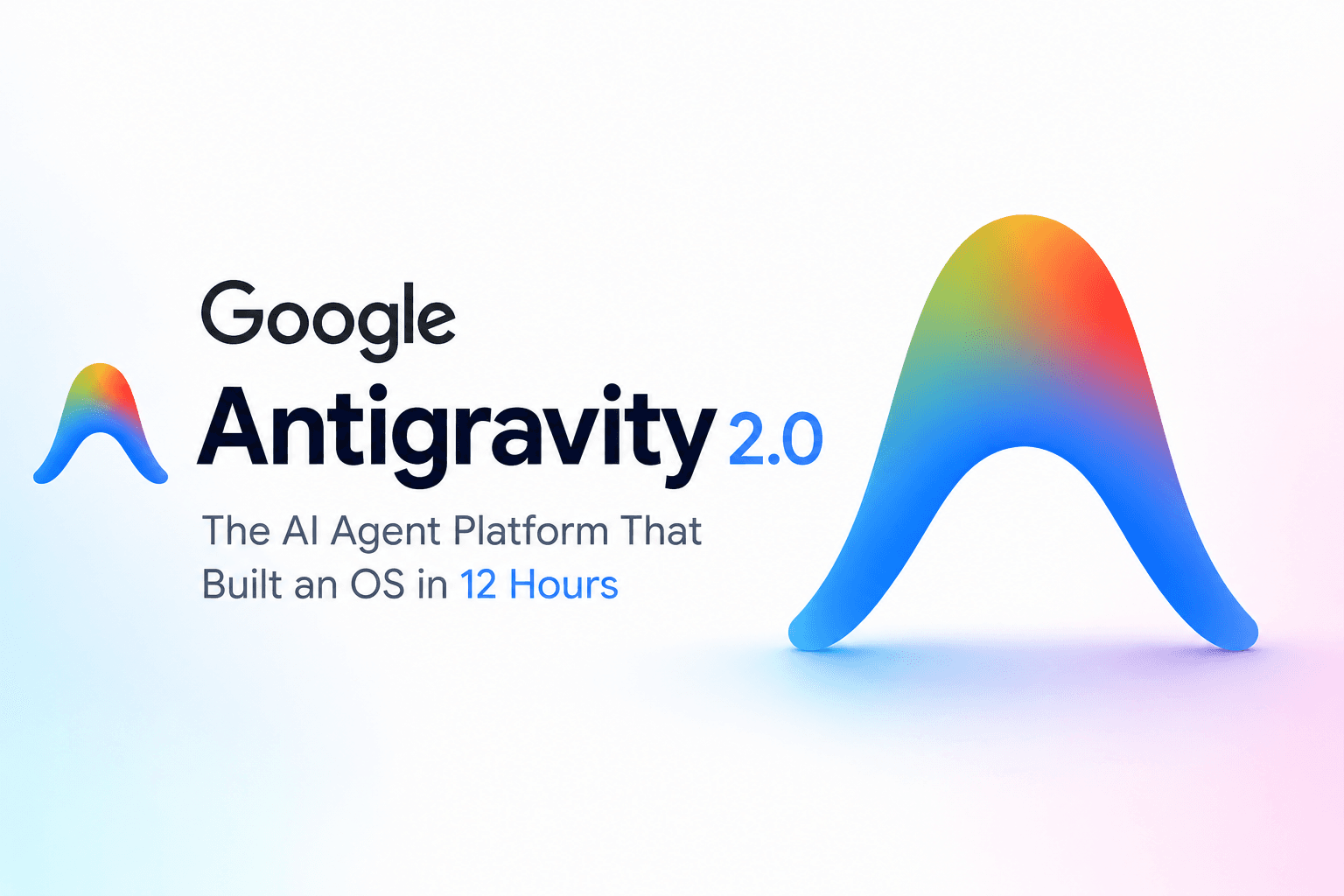
Google just raised the bar for what an AI development platform can do — and it did it live on stage at Google I/O 2026. The star of the show was Google Antigravity 2.0, a brand-new standalone desktop app built from the ground up to orchestrate multiple autonomous AI agents working in parallel.
To prove it, Google's team used Antigravity 2.0 and Gemini 3.5 Flash to build a functioning operating system from scratch in under 12 hours — 93 parallel sub-agents, 2.6 billion tokens, all for less than $1,000 in API credits. Then they ran Doom on it.
What Is Google Antigravity 2.0?
Google Antigravity is Google's agent-first development platform — designed to take an idea from a prompt all the way to a production-ready app. Think of it less as a coding assistant and more as a command center for autonomous AI agents.
Version 2.0 is a dedicated standalone desktop app — separate from the existing Antigravity IDE — built entirely around parallel agent execution, background automation, and deep Google ecosystem integration.
"Antigravity 2.0 is our standalone desktop app built to orchestrate multiple agents to execute tasks in parallel." — Google Antigravity Team, Google I/O 2026
This is not a visual refresh. The 2.0 version is a fundamentally new product surface with a different execution model, built from the ground up to handle multi-agent workflows at a scale that wasn't previously accessible to individual developers or small teams.
The OS Demo: What Actually Happened
Google's team used Antigravity 2.0 to build the core framework of a working operating system from scratch — then attempted to run Doom on it. The demo hit a snag (missing keyboard drivers), and instead of a manual fix, Google instructed Antigravity 2.0 to generate the required drivers in real time. It did. Doom ran.
OS Build Benchmark
Antigravity 2.0 OS Demo — Key Stats
Live demo at Google I/O 2026
The key detail here is what happened when the demo failed mid-run. Most AI-assisted demos would stop and require a human to fix the problem manually. Antigravity 2.0 self-corrected without human intervention — generating the missing keyboard drivers on the fly. That's not just impressive engineering; it redefines what autonomous agents can do in production environments.
Key Features of Antigravity 2.0
Multi-Agent Orchestration
Run multiple specialized agents simultaneously, each assigned a distinct workstream. They share context, hand off tasks, and operate within a unified sandboxed environment with credential masking and hardened Git policies.
Dynamic Subagents for Parallel Workflows
Antigravity 2.0 automatically spins up subagents to break complex tasks into parallel tracks — one agent for UI, another for the API layer, a third running tests, all at once. The OS demo used 93 of these simultaneously.
Scheduled Background Tasks
Define recurring tasks that run automatically in the background, converting Antigravity from a reactive tool into a persistent automation pipeline. This is a critical differentiator from most coding assistants on the market.
Native Voice Commands
Issue instructions to your agents conversationally, consistent with the voice-first direction across Google's broader product suite. This lowers the barrier to entry for non-technical stakeholders directing agent workflows.
Ecosystem Integrations
Native integrations with Google AI Studio, Android, and Firebase — plus one-click deploy to Cloud Run and full project state export from AI Studio. If you're already in the Google ecosystem, Antigravity 2.0 slots in with minimal setup.
The Full Antigravity Ecosystem
The desktop app is the flagship, but Google launched an entire developer ecosystem around it at I/O 2026.
| Product | What It Does | Best For |
| Antigravity 2.0 (Desktop App) | Standalone orchestrator for parallel autonomous agents. | Complex engineering tasks & background automations. |
| Antigravity CLI & SDK | Terminal-based agent controls & programmatic environment. | CI/CD integration & scripting custom agent workflows. |
| Google AI Studio | Prototyping interface with direct project state export. | Fast agent design & system prompting experiments. |
| Managed Agents API | API to spin up agents in Google-hosted sandboxed Linux containers. | Production app integrations and secure runtime logic. |
If you're still using the Gemini CLI, Google is officially urging migration to the Antigravity CLI. It preserves Agent Skills, Hooks, Subagents, and Extensions (now rebranded as Antigravity Plugins). The migration is designed to be low-friction, and the new CLI adds significant capability over the old tool.
Powered by Gemini 3.5 Flash
Antigravity 2.0 runs on Gemini 3.5 Flash, which outperforms Gemini 3.1 Pro across almost all benchmarks and runs 4x faster than other frontier models in tokens per second.
When coordinating 93 sub-agents and 2.6 billion tokens in a single workflow, latency compounds. The 4x speed advantage doesn't just save time — it makes use cases economically viable that simply weren't before. The sub-$1,000 OS build only happened because of this speed-to-cost ratio.
Gemini 3.5 Flash sits in its own quadrant for intelligence vs. output speed compared to all current frontier models. It is available now in Antigravity 2.0 and across Google APIs, with no waitlist for API access.
Managed Agents in the Gemini API
Google is opening up the exact same agent harness they use internally. In a single API call, you get both the agent and a secure hosted Linux environment — Google handles all infrastructure so you focus entirely on user experience and business logic.
Custom Managed Agent templates are rolling out via Google AI Studio. Native Kotlin/Android support in AI Studio lets you build and publish Android apps from a prompt directly to the Play Console test track — a workflow that could compress weeks of mobile development into hours.
More from Google I/O 2026
Gemini Spark — Your 24/7 Personal Agent
A personal AI agent in the Gemini app that works around the clock even when your laptop is closed. Built on the Antigravity harness, starting with Google tools, expanding to third-party tools via MCP. Beta for AI Ultra users in the US this week.
Gemini Omni — Multimodal Everything
Combines Gemini intelligence with generative media models for a new tier of multimodal understanding and editing, starting with video. Omni Flash is rolling out now to AI Plus, Pro, and Ultra subscribers globally, including YouTube Shorts.
The Biggest Search Upgrade in 25 Years
Gemini 3.5 Flash powers new agentic capabilities in Google Search, including what Sundar Pichai called Google's biggest search box upgrade in 25 years — rolling out globally this month.
SynthID Watermarking Goes Industry-Wide
OpenAI, Kakao, and ElevenLabs are joining NVIDIA in adopting Google's SynthID invisible watermark — a major step toward industry-wide AI content provenance standards.
Who Is Antigravity 2.0 For?
Antigravity 2.0 is designed for developers and teams who want to move faster by delegating the heavy lifting to autonomous agents.
- Solo developers — Parallel agents mean one person can run what previously required a full team.
- Engineering teams — The SDK and Managed Agents API let teams embed Antigravity-grade agents into their own products.
- Android developers — Native Kotlin support and Android CLI make this a compelling upgrade for mobile engineers.
- DevOps & automation engineers — Scheduled tasks + sandboxed execution make it a legitimate automation layer, not just a coding helper.
If you're outside the Google ecosystem, the Firebase and Android-centric integrations are less immediately relevant — but the core agent orchestration platform is model-agnostic at the API level, and third-party tool support is expanding via MCP.
Editorial Verdict
Google Antigravity 2.0 isn't just a product update — it's a signal that AI-assisted coding is giving way to AI-executed engineering. The OS demo in 12 hours for under $1,000 is the kind of benchmark that rewires how developers think about what's possible.
Combine that with Gemini 3.5 Flash's speed advantage, the clean Managed Agents API, and the growing CLI/SDK/Studio ecosystem — and this is comfortably one of the most important AI developer tool launches of 2026.
What we like: Genuine parallel-agent architecture. Under-$1K operating cost for extremely complex tasks. Background scheduling as a first-class feature. Thoughtful Gemini CLI migration path. Security-first design — sandboxing, credential masking, hardened Git.
What to watch: Enterprise reliability at scale is still proving ground. Third-party MCP integrations for Gemini Spark are coming but not fully here yet. For teams outside the Google ecosystem, the Firebase/Android-centric integrations may feel less immediately relevant.