HomeAI ToolsReviews
HyzenPro
CompareGuidesAboutSubmit Tool
HyzenPro
HomeAI ToolsReviewsCompareGuidesAbout
Submit a Tool

Stay Ahead with AI

Get weekly AI tool reviews, comparisons & tutorials delivered to your inbox.

HyzenPro logo

Focused AI tool reviews, comparisons, and matchers for creators, marketers, and lean teams.

AI Tools

  • All Tools
  • Video Tools
  • Writing Tools
  • Coding Tools
  • Image Tools
  • Automation

Blog

  • Latest Posts
  • Reviews
  • Tutorials
  • Comparisons

Guides

  • Small Business AI Tools
  • AI Automation Guide
  • AI Writing Tool Guide
  • AI Marketing Tools
  • AI Video Tools

Company

  • About Us
  • Contact
  • How We Test
  • Advertise
  • Submit Tool

Legal

  • Privacy Policy
  • Terms of Service

Latest from the Blog

View all posts
01

OpenClaw Review: Best Open-Source Agentic AI Gateway for M…

May 24, 2026
02

Manus AI Review: Best Agentic AI for Hands-On Autonomous T…

May 24, 2026
03

Hermes Agent Review: Top Self-Improving Open-Source Agenti…

May 24, 2026
04

Top 5 Best Frontier AI Models in 2026: GPT-5.5, Claude, Ge…

May 21, 2026

© 2026 HyzenPro. All rights reserved.

Made with ❤️ for the AI community

HomeBlogTop 5 Frontier AI Models 2026
AI ToolsAI BenchmarksLLM Comparison

Top 5 Best Frontier AI Models in 2026: GPT-5.5, Claude, Gemini & More

Discover the top 5 best frontier AI models in 2026: GPT-5.5, Claude Opus 4.7, Gemini 3.1 Pro, Grok 4, and DeepSeek V4-Pro, compared across real-world benchmarks and use cases.

HyzenPro EditorialMay 21, 20269 min read
Top 5 Best Frontier AI Models in 2026: GPT-5.5, Claude, Gemini & More

Think about what it was like to use AI just two years ago. You typed a question, got a decent answer, and moved on. That was it.

Fast forward to 2026, and AI models are now writing full codebases, passing medical exams, handling legal documents, running business workflows, and having conversations that genuinely feel human. The pace of improvement has been nothing short of staggering.

But here's the thing — not all AI models are built the same. Some are brilliant at reasoning, others crush it at coding, and some just feel incredibly natural to talk to. At the very top of this hierarchy sits a small, elite group called frontier models.

In this guide, we break down exactly what a frontier model is, why it matters, and which five models are leading the race in 2026. Whether you're a developer, a business owner, or just someone trying to figure out which AI tool is actually worth your time — this is for you.

What Is a Frontier Model?

Before we jump into rankings, let's clear something up — because this term gets thrown around a lot.

A frontier model is not just any AI model. It refers to the most capable, most advanced AI systems available at any given point in time. These are the models pushing the absolute boundary of what artificial intelligence can do — right at the cutting edge of science, not just incremental improvements on what came before.

Think of it like this: if AI were Formula 1 racing, frontier models are the cars competing at the very front of the grid. Everything else — your cheaper, faster, lighter models — are built inspired by what frontier models prove is possible first.

Here's what makes a model "frontier-level":

  • Expert-level reasoning — it can solve problems that stump most humans
  • Broad knowledge — it's not a one-trick pony; it handles coding, writing, science, math, and more
  • Massive scale — trained on enormous amounts of data with billions (or trillions) of parameters
  • Benchmark dominance — it leads on industry-standard tests like SWE-Bench, MMLU-Pro, ARC-AGI-2, and AIME
  • Multimodal ability — it can understand text, images, documents, and increasingly audio/video

In 2026, frontier models have become genuinely useful tools — not just research experiments. They're being deployed in hospitals, law firms, software companies, and schools. The stakes are real, and the competition is fierce.

Why the Frontier Model Race Matters in 2026

The gap between frontier models and everything else is actually shrinking. Open-source models like DeepSeek are catching up fast, pricing has dropped 30–60% across the board, and context windows now stretch to a million tokens or more.

But the frontier keeps moving forward. What was cutting-edge in 2025 is now mid-tier. And choosing the wrong model for your workflow can cost you time, money, and quality.

So let's get into the rankings.

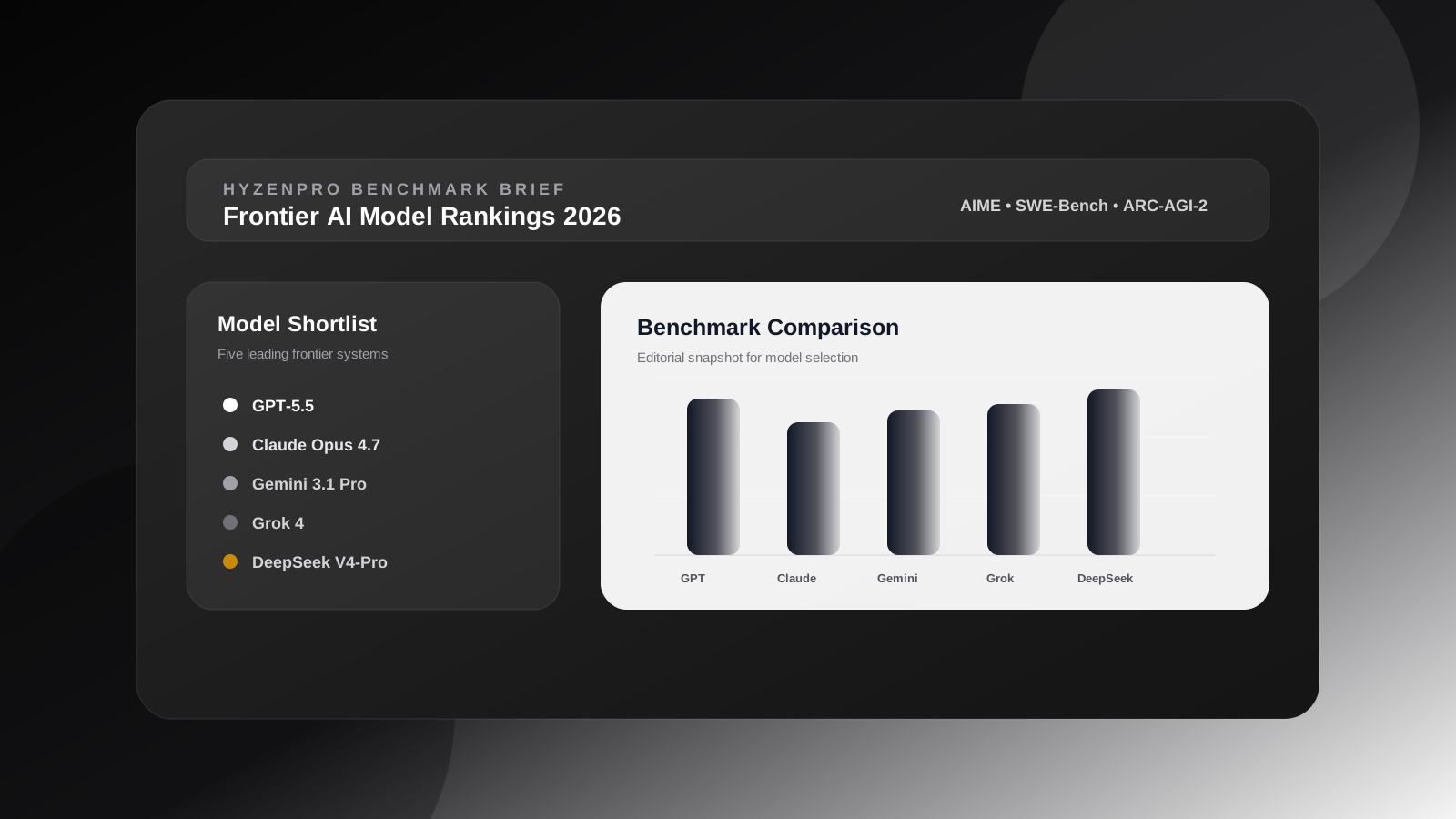
// benchmark analysis · may 2026

Frontier AI Model Rankings

Verified scores from SWE-Bench, AIME 2025, ARC-AGI-2 & more · May 2026

◆
GPT-5.5
OpenAI
Math LeaderAll-Rounder
◆
Claude Opus 4.7
Anthropic
Writing #1Agentic #1
◆
Gemini 3.1 Pro
Google
Reasoning #11M Context
◆
Grok 4
xAI
Coding #1Real-Time Web
◆
DeepSeek V4-Pro
DeepSeek
Open-Weight #1Self-Hostable

All-Model Radar — 5 Benchmarks

* Scores verified against Artificial Analysis, BenchLM & SWE-Bench · May 2026

GPT-5.5 — OpenAI's All-Around Champion

If there's one name the world knows in AI, it's GPT. And GPT-5.5 lives up to that reputation.

OpenAI's latest flagship isn't just an upgrade — it's a rethinking of what a general-purpose AI model should look and feel like. It's fast, sharp, and handles just about everything you throw at it with remarkable confidence.

What makes GPT-5.5 stand out:

GPT-5.5 leads the math benchmarks in 2026, hitting a 95.2% score on AIME 2025 — a test that would challenge most PhD students. It also scores among the highest on human preference evaluations, which means people don't just find it accurate — they genuinely enjoy using it.

It's been designed as a "unified system," meaning it intelligently decides how much compute and reasoning to apply depending on the complexity of your question. Simple query? Quick, clean answer. Complex research task? It goes deep.

Best for: Math, data analysis, academic research, general productivity, creative writing

Pricing model: API access available; ideal for teams and enterprise users

Want to explore GPT-5.5's capabilities in detail before committing? Check out the full GPT-5.5 profile on HyzenPro — it breaks down use cases, pricing, and a side-by-side comparison with other top models.

Claude Opus 4.7 — The Best AI for Writing and Agentic Work

Anthropic's Claude Opus 4.7 is, in many people's minds, the most human of the frontier models. If you've ever written something with Claude and felt like the output actually sounds like a person wrote it — that's not an accident. It's a design philosophy.

But Opus 4.7 isn't just a great writer. It's also the leading model for agentic AI tasks — meaning it's exceptional at operating across multiple tools, systems, and workflows autonomously.

What makes Claude Opus 4.7 stand out:

It debuted at #1 for agentic development thanks to best-in-class MCP-Atlas tool use at 77.3%, making it the strongest model for multi-tool orchestration. The new xhigh effort level and adaptive thinking give you finer control over how deeply it reasons through complex problems.

The Claude Opus 4.7 page on HyzenPro is worth a read — it has detailed notes on exactly what this model does better than any other for writers and content teams.

Gemini 3.1 Pro — Google's Reasoning and Context Powerhouse

Google has been quietly (and not so quietly) building one of the most capable AI systems on the planet. Gemini 3.1 Pro is the result of that work — and it's impressive.

Where Gemini 3.1 Pro truly shines is reasoning and long-context understanding. If you're dealing with massive documents, complex multi-step logic problems, or anything that requires holding a lot of information at once — this is your model.

What makes Gemini 3.1 Pro stand out:

It leads the ARC-AGI-2 reasoning benchmark at 77.1% — a test that specifically targets abstract problem-solving that's hard to game with brute-force training. It also supports a 1 million token context window, which means you can feed it entire books, codebases, or research libraries in a single session.

For teams looking to automate complex reasoning tasks at scale, explore the Gemini Flash profile on HyzenPro to see how Google's model family fits into broader automation pipelines.

Grok 4 — xAI's Coding Powerhouse

Elon Musk's xAI has surprised a lot of people with Grok 4. A year ago, Grok was considered an interesting experiment. Today, it's a genuine competitor — and the best model in the world for certain coding tasks.

What makes Grok 4 stand out:

Grok 4 leads raw SWE-bench scores at 75%, which is the industry's gold standard for evaluating how well an AI can solve real-world software engineering problems. That puts it slightly ahead of GPT-5.4 and neck-and-neck with Claude in coding scenarios.

It's also deeply integrated with real-time web data through X (formerly Twitter), giving it an edge when you need a model that's aware of what's happening right now — not just what it was trained on six months ago.

DeepSeek V4-Pro — The Open-Weight Frontier Breaker

DeepSeek V4-Pro might be the most important model on this list for a reason that has nothing to do with benchmark scores: it's open-weight, MIT-licensed, and delivers genuine frontier-class capability.

That means you can self-host it. No API costs. No data sent to a third party. Full control.

What makes DeepSeek V4-Pro stand out:

It scores 82.6% on SWE-Bench — which is remarkable for an open model — and supports a 1 million token context window. For companies with strict data privacy requirements, regulated industries, or simply teams that want to keep AI costs predictable, DeepSeek V4-Pro is a game-changer.

Quick Comparison: 2026 Frontier Models at a Glance

Model Best At Context Window Pricing Tier
GPT-5.5 Math, all-around Large Premium
Claude Opus 4.7 Writing, agentic Large Premium
Gemini 3.1 Pro Reasoning, long context 1M tokens Mid-Premium
Grok 4 Coding Large Mid-Premium
DeepSeek V4-Pro Open-weight, privacy 1M tokens Free (self-host)

How to Pick the Right Frontier Model for You

Here's the honest truth: there's no single "best" model. The right choice depends entirely on what you're doing.

You're a developer or engineer → Start with Grok 4 for raw coding tasks, or Claude Sonnet 4.6 for a more balanced coding and reasoning experience. You can see how Claude Sonnet 4.6 performs across coding benchmarks here.

You're building automated workflows → Claude Opus 4.7 for complex multi-step agentic tasks, or look at Claude Haiku for lightweight, fast automation. Claude Haiku 4.5 is worth exploring for cost-effective automation — it punches well above its price point.

You're a content creator or marketer → Claude Opus 4.7 for long-form writing, or GPT-5.5 for versatile content and research. For teams managing high-volume content, GPT-5.4 is another strong option that balances quality and throughput.

You're in a regulated industry → DeepSeek V4-Pro if you can self-host, or Gemini 3.1 Pro for its long context and reasoning depth.

You're just getting started → GPT-5.5 for its ecosystem, ease of use, and breadth of capability.

What's Next for Frontier AI?

The pace isn't slowing down. What we're seeing in 2026 is the beginning of a new phase — where frontier models aren't just answering questions, they're taking actions. Running pipelines. Writing and deploying code. Making decisions inside business systems.

The competition has also made AI remarkably affordable. Prices have fallen 30–60% compared to 2025. Open-weight models like DeepSeek are closing the capability gap with closed models fast. And context windows are now so large that a single session can hold an entire company's knowledge base.

It's a genuinely exciting time to be paying attention.

Final Thoughts

Frontier AI models in 2026 are no longer just impressive — they're useful. Genuinely, practically useful in ways that can change how you work, build, and create.

GPT-5.5 is the reliable all-rounder. Claude Opus 4.7 is the best for writing and agentic workflows. Gemini 3.1 Pro wins on reasoning and long context. Grok 4 dominates coding. And DeepSeek V4-Pro opens the frontier to anyone who wants to self-host.

Pick the one that fits your work — and don't be afraid to use more than one. Most professionals in 2026 already do.

Frontier AI ModelsGPT-5.5Claude Opus 4.7Gemini 3.1 ProGrok 4DeepSeek V4AI BenchmarkLarge Language ModelsAI Comparison

Continue your research

Build a stronger shortlist

AI tools directoryBrowse every published AI tool review and category page.AI tool matcherUse guided questions to move from research to a practical shortlist.How we test AI toolsReview the evaluation method behind HyzenPro recommendations.
HyzenPro AI Tool Matcher

Want a faster path to the right AI tool?

Use the matcher hub to move from broad browsing into a guided shortlist based on workflow, budget, and team context.

Open the matcher hubBrowse the full directory

About the Author

HE

HyzenPro Editorial

AI Model Analyst & Reviewer

The HyzenPro editorial team analyzes frontier AI models, runs benchmarks, and provides actionable insights to help professionals choose the right tools.

✓Expert Verified
🔬Hands-on Testing

Share This Article

TABLE OF CONTENTS

  • What Is a Frontier Model?
  • Why the Frontier Model Race Matters in 2026
  • GPT-5.5 — OpenAI's All-Around Champion
  • Claude Opus 4.7 — The Best AI for Writing and Agentic Work
  • Gemini 3.1 Pro — Google's Reasoning and Context Powerhouse
  • Grok 4 — xAI's Coding Powerhouse
  • DeepSeek V4-Pro — The Open-Weight Frontier Breaker
  • Quick Comparison: 2026 Frontier Models at a Glance
  • How to Pick the Right Frontier Model for You
  • What's Next for Frontier AI?
  • Final Thoughts

Related Articles

OpenClaw Review: Best Open-Source Agentic AI Gateway for Messaging Apps (2026)
AI ToolsReviews
HyzenPro TeamMay 24, 20263 min

OpenClaw Review: Best Open-Source Agentic AI Gateway for Messaging Apps (2026)

OpenClaw 2026 review — open-source agentic AI gateway for custom workflows, messaging integration, features, deployment, and pros/cons vs Hermes Agent.

Read More
Hermes Agent Review: Top Self-Improving Open-Source Agentic AI (2026)
AI ToolsReviews
HyzenPro EditorialMay 24, 20263 min

Hermes Agent Review: Top Self-Improving Open-Source Agentic AI (2026)

Hermes Agent by Nous Research 2026 review — self-improving open-source agentic AI with pricing, setup, memory capabilities, pros/cons vs Manus and OpenClaw.

Read More
Manus AI Review: Best Agentic AI for Hands-On Autonomous Task Execution (2026)
AI ToolsReviews
HyzenPro EditorialMay 24, 20263 min

Manus AI Review: Best Agentic AI for Hands-On Autonomous Task Execution (2026)

Manus AI 2026 review — features, complete pricing tiers, pros/cons, and alternatives. Discover the top agentic AI for completing real-world tasks like research reports, presentations, and web automation.

Read More

Stay Ahead with AI

Get weekly AI tool reviews, comparisons & tutorials delivered to your inbox.

HyzenPro logo

Focused AI tool reviews, comparisons, and matchers for creators, marketers, and lean teams.

AI Tools

  • All Tools
  • Video Tools
  • Writing Tools
  • Coding Tools
  • Image Tools
  • Automation

Blog

  • Latest Posts
  • Reviews
  • Tutorials
  • Comparisons

Guides

  • Small Business AI Tools
  • AI Automation Guide
  • AI Writing Tool Guide
  • AI Marketing Tools
  • AI Video Tools

Company

  • About Us
  • Contact
  • How We Test
  • Advertise
  • Submit Tool

Legal

  • Privacy Policy
  • Terms of Service

Latest from the Blog

View all posts
01

OpenClaw Review: Best Open-Source Agentic AI Gateway for M…

May 24, 2026
02

Manus AI Review: Best Agentic AI for Hands-On Autonomous T…

May 24, 2026
03

Hermes Agent Review: Top Self-Improving Open-Source Agenti…

May 24, 2026
04

Top 5 Best Frontier AI Models in 2026: GPT-5.5, Claude, Ge…

May 21, 2026

© 2026 HyzenPro. All rights reserved.

Made with ❤️ for the AI community